PetroChina’s Qinghai oilfield: microbes at field scale
WellsProducing wells in high-salinity, low-permeability reservoirs. In 2025, 1,353 of them were on microbial wax control.
TreatmentMicrobes native to the field, mainly Bacillus strains, used for wax removal and prevention, huff-puff stimulation and H₂S control.
ResultAbout 169,000 more barrels of oil and $8.3 million of direct economic benefit in 2025.
Wax control, 1,353 wells
110,000 bbl
of added oil in 2025, with 3,700+ fewer hot-oil and hot-water wash jobs, $1.5 million+ saved and 10+ more producing days per well a year.
Huff-puff stimulation, 167 jobs
+5.3 bbl/day
per well, with over 70% of jobs effective and 59,000 bbl of added oil in 2025.
H₂S control
6 sour wells → zero
H₂S for 140+ days, and two gathering systems held within 10 ppm.
Earlier field trials
| Trial | Result | Added oil |
|---|
| 2019–20 · wax removal | Wax removed in 81% of tested wells; hot-wash cycle 30 days longer | 8,100 bbl |
| 2023 · wax + huff-puff | Hot-wash cycle 47 days longer on average | 10,700 bbl |
| 2024 · oil-displacement agent | Input-to-output ratio of 1 : 6.6 in low-to-medium permeability reservoirs | 28,800 bbl |
Source: P. Sun et al., Microbes facilitate crude oil production in plateau oilfields, Engineering Microbiology 6, 100287 (2026), by PetroChina Qinghai Oilfield Company and Shandong University. Barrels and dollars are approximate, converted from the paper’s metric tons, cubic meters and yuan at 7.33 bbl per ton, 6.29 bbl per m³ and the 2025 average of 7.19 yuan per US dollar.
Four vertical wells, Bottineau County, North Dakota
WellsFour producing wells completed between 1959 and 1976, making 101 to 357 barrels of oil a month before treatment.
Treatment1 gallon of ChainBreaker in 1 barrel of water, pumped down the backside and shut in for 8 hours. Well 1 was treated monthly; Well 2 two months in a row.
ResultOil up 40% to 213% per well, comparing averages of 4 to 5 months before and after.
Before treatmentAfter treatmentBarrels of oil a month
Source: BioActive Services, Bottineau County case histories 1–4.
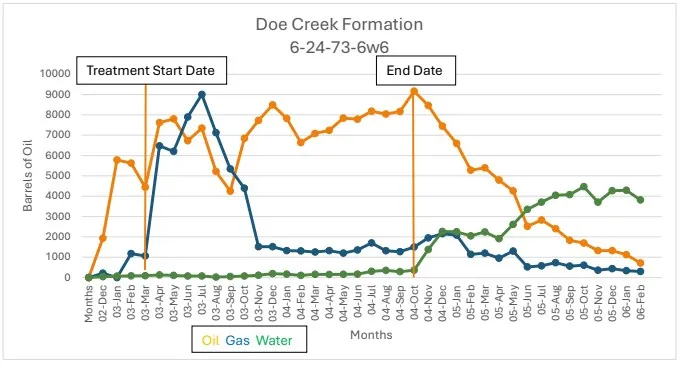
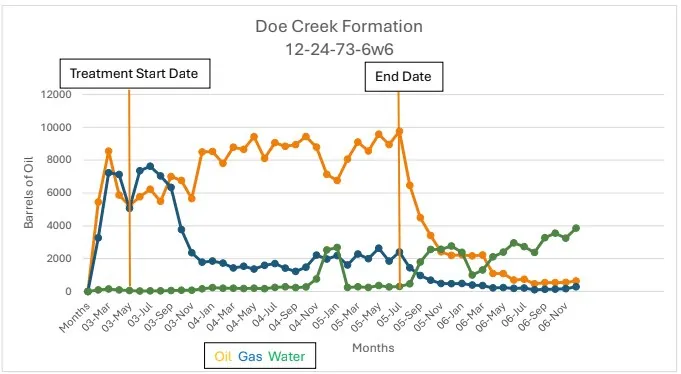
Two Doe Creek Formation wells
Wells6-24-73-6W6 and 12-24-73-6W6.
TreatmentOngoing treatment between the marked start and end dates: March 2003 to October 2004, and May 2003 to July 2005.
ResultMonthly oil climbed and then held while treatment continued. After treatment ended, oil fell steeply and water rose.
Oil in orange, gas in blue, water in green. Source: Hiltek Resource Recovery and BioActive Services presentation.
Eastern Kansas waterflood
ProblemTubing typically lasted only 8 to 12 months before corrosion holes forced it to be pulled.
TreatmentBioActive microbial treatment, starting around 2020.
ResultTubing in the hole more than 3 years came out “nice and shiny,” with corrosion mitigated. Oil for the 5 years from 2020 was 25,716 barrels, against 22,131 for the 5 years before 2019.
- Extra oil over 5 years+3,585 bbl
- Value at $55 a barrel$197,175
- 2024 (10 months of data)On track for 5,084 bbl
Source: BioActive Services, Eastern Kansas Water Flood case history.
ProblemParaffin buildup: cleaning pigs got stuck in the line, and hard wax built up in a 10,000-barrel tank.
TreatmentContinuous injection of 30 liters (8 gallons) a day.
ResultParaffin in the pig barrel turned “soft and supple,” pigs no longer got stuck, and the paraffin in the tank disappeared; cleanout took only a squeegee.
Source: BioActive Services, Pipeline case history.