
Heavy oil
Producing Heavy Oil
The biggest upside may be oil that has already been found. Heavy oil, below 20° API, is too thick to flow or pump economically with conventional methods, and steam, the usual answer, is costly. So known barrels sit in the ground.
Billions of barrels, already found
The Kentucky Geological Survey notes that the western Kentucky deposits have been developed “periodically for more than 100 years, depending on price and market considerations.” The oil is known. The question is whether it can be produced at a profit.
Too thick to pump, too costly to heat
Viscosity
Heavy oil resists flowing from the rock to the wellbore and up the tubing, so rates stay low and pumps work harder.
Cold weather
It thickens further as it cools, which makes it hard to pump and sell in winter, a problem many leases already pay to manage.
Cost
Steam, the usual answer, is expensive to generate and handle, so many known deposits never make it past the economics.
Thinner oil that moves
Microbes break down the heaviest fractions of the oil, lowering its average molecular weight, and produce biosurfactants, acids and gas that cut viscosity and help the oil move. In lab studies, microbes cut heavy-oil viscosity by 29–55% (review, 2014).
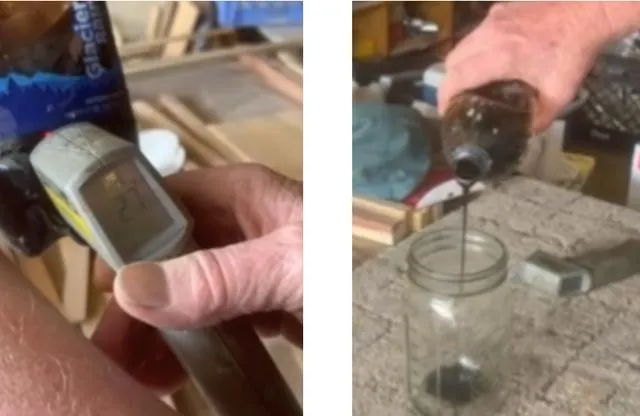
In BioActive’s test, 18° API heavy oil still poured at 27°F (−3°C) after ChainBreaker treatment.
Heavy-oil results from MEOR field programs
Viscosity 115 → 50 cp
About 37,000 extra barrels over three years, at $2.90 per incremental barrel (OGJ).
Viscosity cut up to 35%
Part of the ONGC and Oil India stripper-well program with TERI (TERI).
1,872 tonnes
Incremental heavy oil from an MEOR field trial (Chai et al., 2015).
Sources for this section
- Hiltek Resource Recovery and BioActive Services, Indiana Oil and Gas presentation (Oct. 27, 2026), slide 25 (Illinois Basin estimate)
- Kentucky Geological Survey, Tar Sands of Western Kentucky and tar sand research
- Shibulal et al., Microbial Enhanced Heavy Oil Recovery by the Aid of Inhabitant Spore-Forming Bacteria: An Insight Review, Scientific World Journal (2014)
- Oil & Gas Journal, MEOR field cases (2009); TERI, MEOR for stripper wells
- Chai et al., MEOR field trial in a low-temperature heavy oil reservoir (2015)
- BioActive Services, heavy oil