
Wellbore BioChemistry Root cause 4 of 7
Asphaltenes in Oil Wells: Causes, Costs and the Remedy
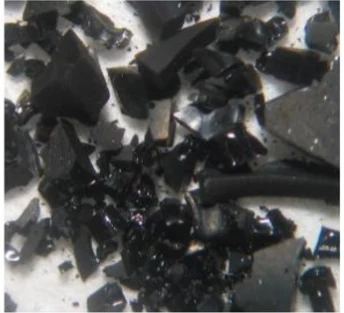
Asphaltenes are the heaviest part of crude oil. When pressure falls or the oil’s chemistry changes, they drop out as hard black solids that choke a well from the bottom up, and they are easy to mistake for wax.
The heaviest part of the crude, knocked out by pressure
 Blockage
- What it is
- The heaviest, most polar part of the crude.
- What causes it
- Pressure falling toward the oil’s bubble point, or CO₂, acid, light solvents or a different crude changing its chemistry, knocks them out of the oil as hard, black, tar-like solids.
- Lifting costs: the usual fixes and why they repeat
- Xylene soaks, coiled-tubing cleanouts and inhibitors that don’t last long. Each new pressure drop brings more out of the oil.
- Profitability
- Deposits choke the well from the bottom up, where the oil enters the wellbore, and asphaltene-stabilized emulsions can be strong enough to plug production.
- Billions of dollars a year across the industry, by ASTM International’s estimate.
- 2.3 to 1.35 inches: how far asphaltene narrowed the tubing bore of one deep well, by model estimate, despite yearly coiled-tubing cleanouts. A solvent soak and a better inhibitor raised its production 16% over four months.
What this does to a well’s life: Lifting Costs and Well Life
ASTM International; Wylde and Punase, JPT (2020).
Asphaltene or paraffin? How to tell them apart in the field
Both come from the oil, both can look black, and they are often found together. But they form for different reasons and need different treatments, and treating asphaltene as wax wastes the job and can make it worse.
| What to check | Paraffin (wax) | Asphaltene |
|---|---|---|
| Looks like | Soft and waxy, light yellow to dark brown; you can dent it with a fingernail | Hard, brittle and shiny black, like broken glass or coal |
| Triggered by | Cooling below the wax appearance temperature | Pressure falling toward the bubble point, or a change in the oil’s chemistry: CO₂, acid, light solvents, mixed crudes |
| Where in the well | Upper tubing, rods and flowlines, where the oil cools: mostly within about 3,000 ft of the surface in a survey of Texas, New Mexico and North Dakota wells | Deep, at the perforations and in the lower tubing, and at chokes and valves where pressure drops sharply |
| Heat test | Softens and melts in hot water | Stays hard; it doesn’t melt |
| Solvent test | Dissolves in warm kerosene or condensate | Stays as black grains in kerosene, condensate or heptane, but dissolves in xylene or toluene |
| Watch out | Hot oiling can push melted wax into the formation, where it can damage permeability | Condensate and other light solvents used on wax can knock more asphaltene out |
Real deposits are often mixtures of wax, asphaltene, iron sulfide, scale and sand, so a lab analysis of the deposit and the oil is the surest guide. A Production Pilot starts with an oil lab test.
Solubility and triggers: SPE PetroWiki, Asphaltenes and waxes and Asphaltene problems in production. Depth and light solvents: Ivanhoe and Herman, Oil & Gas Journal (1999).
What ChainBreaker does about asphaltenes
BioActive reports its microbes degrade asphaltenic sludge, and biosurfactants loosen the deposit from steel and rock. Hard deposits at the perforations may still need a solvent soak; the lab test above shows which.
Sources for this section
- Hiltek Resource Recovery and BioActive Services, Indiana Oil and Gas presentation (Oct. 27, 2026), slides 2–3, 7–23 and 25
- SPE PetroWiki, Asphaltenes and waxes and Asphaltene problems in production
- BioActive Services, ChainBreaker
- BioActive Services, notes on the ChainBreaker microbial consortium and the biochemicals it makes (Oct. 2026)
- BioActive Services, Paraffin and Asphaltene Control
- K. Ivanhoe and J. Herman, Paraffin, asphaltene control practices surveyed, Oil & Gas Journal (July 12, 1999)
- ASTM International, New ASTM test method helps reduce problem of asphaltenes in oil production
- J. Wylde and A. Punase, Asphaltenes: A Complex and Challenging Flow Assurance Issue To Measure and Quantify Risk, JPT (Apr. 30, 2020)
- Asphaltene photo: Hiltek Resource Recovery (Nov. 2026); downhole event costs: Hiltek Resource Recovery, typical ranges in the profitability calculators