
Wellbore BioChemistry Root cause 6 of 7
Emulsions and Water Separation: Costs and the Remedy
When oil and water won’t separate, a lease pays for demulsifier and heat, risks off-spec oil and loses oil to the disposal well.
Water in the oil, oil in the water
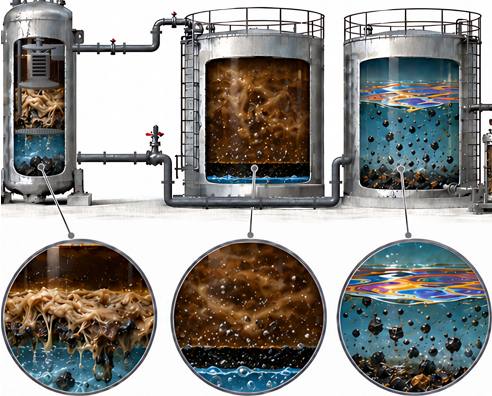
- What it is
- Oil and water that won’t separate.
- What causes it
- The pumps make droplets, and fine solids, asphaltenes and slime coat them so they can’t merge.
- Lifting costs: the usual fixes and why they repeat
- Demulsifiers, heat and tank cleanouts, batch after batch, as long as the solids and slime keep making new emulsion.
- Hidden cost
- The rag layer of oil-wet solids crowds the separator and cuts the time oil and water have to separate.
- Profitability
- Water left in the oil can push it off spec, and oil left in the water goes down the disposal well.
What this does to a well’s life: Lifting Costs and Well Life
The cost of oil in the water
Poor separation sends saleable oil down the disposal well. Cleaner separation keeps it in the sales tank. In this example, a modest oil concentration costs about $900 a month. To count it for your lease, enter your disposal water and its oil content in the Stripper Well or Fracked Well calculator.
- Disposal water rate500 bbl/day
- Oil concentration750 ppmw
- Process temperature45 °F
- Oil gravity32 °API
- Net oil price$70.00/bbl
- Oil lost each month13.0 bbl
- Monthly financial loss$910.62
Cleaner surface equipment starts in the wellbore
The wax, iron sulfide, slime and emulsion that build up in tank bottoms, treaters and flowlines come up the tubing. Treating the wellbore, where they start, sends less of them to the surface, so over time the equipment needs fewer cleanouts.
BioActive reports:
- Annual tank and treater cleaningsnone in 5 years
- Flowline breaks in one well field2 in 5 years
What ChainBreaker does about emulsions
Biosurfactants, ChainBreaker’s main byproduct, break the films that hold oil and water droplets apart, in standard and reverse emulsions, while the microbes cut the iron sulfide and slime that feed the emulsion. BioActive reports they dramatically improve water separation and significantly reduce emulsions.
The goal is cleaner separation and lower BS&W, which you can check with bottle tests and BS&W trends before and after treatment.
Sources for this section
- Hiltek Resource Recovery and BioActive Services, Indiana Oil and Gas presentation (Oct. 27, 2026), slides 2–3, 7–23 and 25
- BioActive Services, ChainBreaker
- BioActive Services, notes on the ChainBreaker microbial consortium and the biochemicals it makes (Oct. 2026)
- Santos et al., Biosurfactants: multifunctional biomolecules of the 21st century, International Journal of Molecular Sciences (2016)
- C. Nikolova and T. Gutierrez, Biosurfactants and Their Applications in the Oil and Gas Industry, Frontiers in Bioengineering and Biotechnology (2021)
- Hamza et al., Review of iron sulfide scale removal and inhibition, Energy & Fuels (2021); Brawley et al., Removing a typical iron sulfide scale (SPE 24327, 1992); Long, Preventing emulsions by mitigating solids, JPT (2016)
- Hiltek Resource Recovery, oil carry-over loss calculator (November 2026): the disposal-water example