
Wellbore BioChemistry Root cause 7 of 7
Microbial Corrosion in Oil Wells: Causes, Costs and the Remedy
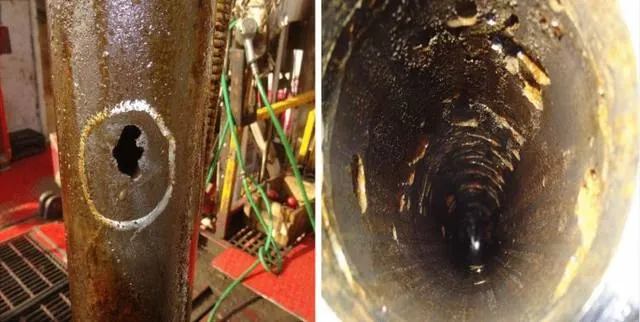
Microbes are blamed for about 20% of corrosion failures. Under their slime, acids and sulfide pit casing, tubing and rods from underneath.
Bacteria that pit steel from underneath
- What it is
- Bacterial slime that eats steel from underneath.
- What causes it
- Under biofilm, sulfide from SRB and organic acids from acid-producing bacteria eat small, deep pits, and deposits hide them until a failure.
- Lifting costs: the usual fixes and why they repeat
- Inhibitors and biocides that can’t reach the steel under the slime, plus replacing corroded tubing and rods.
- Profitability
- Every leak or parted string means a pulling job and days of lost production.
- $1.372 billion a year: the cost of corrosion in U.S. oil and gas production, including $463 million for downhole tubing.
What this does to a well’s life: Lifting Costs and Well Life
NACE corrosion cost study (AMPP).
A team of bacteria that protects itself
Slime is biofilm: microbes glued to a surface inside a matrix they make themselves. Each layer does a different job.
- Where it meets airSulfur-oxidizing bacteria (SOB)Turn H₂S into sulfur and sulfuric acid, which can drive pH to 1 or below, and regenerate sulfate for the SRB. They live in tank roofs and vapor spaces, gun barrels, pits and vents.
- Top of the slimeSlime formersBuild the slime and use up the oxygen, so the bottom stays oxygen-free even when the water around it is not.
- MiddleAcid-producing bacteria (APB)Turn oil compounds into organic acids that attack steel and feed the SRB.
- Against the steelSulfate-reducing bacteria (SRB)Give off H₂S and deposit iron sulfide. The black crust conducts electricity, and the steel under it corrodes into deep pits.
- BelowSteelCasing, tubing, rods and tanks: pitted where the deposits sit.
Testing can mislead. Water samples count free-floating bacteria, but the ones in slime usually matter most.
Not all slime is harmful. Research shows some biofilms protect steel and others attack it, depending on the species.
What ChainBreaker does about corrosion
ChainBreaker loosens biofilm and the deposits that shelter it, and competes with acid- and sulfide-making bacteria for surfaces and food, so less acid and sulfide reach the steel.
BioActive reports its microbes also make polysaccharides that coat tubing and rods with a film that guards against corrosion, as a corrosion inhibitor does. With the paraffin removed, the film can reach the metal.
In an Eastern Kansas waterflood, tubing that used to last 8 to 12 months came out “nice and shiny” after more than three years (case study).
Keep the safeguards. Keep corrosion monitoring and inhibitors until your data shows a sustained improvement.
Sources for this section
- Hiltek Resource Recovery and BioActive Services, Indiana Oil and Gas presentation (Oct. 27, 2026), slides 2–3, 7–23 and 25
- BioActive Services, ChainBreaker
- BioActive Services, notes on the ChainBreaker microbial consortium and the biochemicals it makes (Oct. 2026)
- Flemming and Wingender, The biofilm matrix, Nature Reviews Microbiology (2010); Tripathi et al., Frontiers in Microbiology (2021)
- S. Genculu, Microbiologically Influenced Corrosion (PDHonline course M507); Enning et al., Corrosion of iron under electroconductive biogenic mineral crust, Environmental Microbiology (2012)
- Institute of Corrosion, An introduction to MIC; Inspectioneering, Understanding microbial corrosion (2022)
- NACE TM0194, Field monitoring of bacterial growth in oil and gas systems; Booker et al., Sulfide generation by dominant Halanaerobium microorganisms, mSphere (2017)
- Kip and van Veen, The dual role of microbes in corrosion, ISME Journal (summary); Karn et al., Frontiers in Microbiology (2017)
- Dolfing and Hubert, Frontiers in Microbiology (2017); Lahme et al., Applied and Environmental Microbiology (2019)
- AMPP (formerly NACE International), Oil and gas production: the NACE corrosion cost study ($1.372 billion a year)