
Wellbore BioChemistry Root cause 2 of 7
H₂S in Oil Wells: Damage, Safety Limits, Costs and the Remedy
Hydrogen sulfide (H₂S) brings two problems: downhole, reactions that eat, crack and plug the well’s steel; where people work, a deadly gas that sets off safety rules at 10 to 20 ppm. In shallow, cool oil wells most of it is made by sulfate-reducing bacteria, so it keeps coming back until the bacteria are dealt with.
A toxic gas the well keeps making
- What it is
- A toxic, corrosive gas.
- What causes it
- Mostly sulfate-reducing bacteria (SRB) living in sludge, wax and slime, downhole and in the tanks.
- Lifting costs: the usual fixes and why they repeat
- Scavenger chemicals every month, gas monitors and safety procedures, and more H₂S each time acid hits iron sulfide. Scavengers bind gas already made while the bacteria keep producing, so the bill keeps coming.
- Profitability
- It sours the oil and gas, which can bring price penalties, and it turns the well’s steel into iron sulfide and corrosion.
What this does to a well’s life: Lifting Costs and Well Life
Inside the well, H₂S sets off a chain of damage
Most people know H₂S as a smell and a safety risk. Downhole it is also a reactant, and every reaction it drives costs money.
- It eats steel. Fe + H₂S → FeS + H₂. Every pound of H₂S that reacts takes about 1.6 pounds of iron out of the casing, tubing and rods and leaves about 2.6 pounds of iron sulfide behind.
- It cracks hard steel. Hydrogen from the same reaction enters the metal. In high-strength steel under load it causes sulfide stress cracking, and parts can snap without warning. Sour-service rules (NACE MR0175/ISO 15156) start at an H₂S partial pressure of 0.05 psia and hold carbon steel to about 22 HRC, and parts have failed below that threshold.
- It plugs and binds. The iron sulfide left behind binds wax into hard “black wax,” fouls pumps and perforations, and coats oil droplets so emulsions won’t break (Paraffin, Emulsions).
- It comes back with acid. An acid job dissolves iron sulfide but sets the H₂S free again: FeS + 2HCl → FeCl₂ + H₂S.
- It turns to acid and fire at the surface. Where air gets in, sulfur-oxidizing bacteria turn H₂S into sulfuric acid (Corrosion), and iron sulfide exposed to air can heat up and ignite on its own, a known cause of fires in sour crude storage.
At 10 to 20 ppm, H₂S becomes a safety program
H₂S is heavier than air, so it pools in tanks, pump houses and low ground. Its rotten-egg smell is no warning: at 100 ppm it deadens the nose within minutes.
| H₂S in the air | What it means |
|---|---|
| 1 ppm | ACGIH’s recommended limit over 8 hours (5 ppm over 15 minutes) |
| 10 ppm | NIOSH ceiling for any 10 minutes; OSHA’s 8-hour limit in construction and shipyards |
| 20 ppm | OSHA’s general-industry ceiling (one peak up to 50 ppm for 10 minutes a shift, if there is no other exposure); Michigan drilling-rig alarms sound; Illinois’ wellhead rule applies (below) |
| 100 ppm | Immediately dangerous to life or health; smell is lost in 2 to 15 minutes |
| 500–700 ppm | Collapse in about 5 minutes; death after 30 to 60 minutes |
| 700 ppm and up | Collapse within one or two breaths; death within minutes |
What working with H₂S takes
- A personal H₂S monitor on every person, every visit
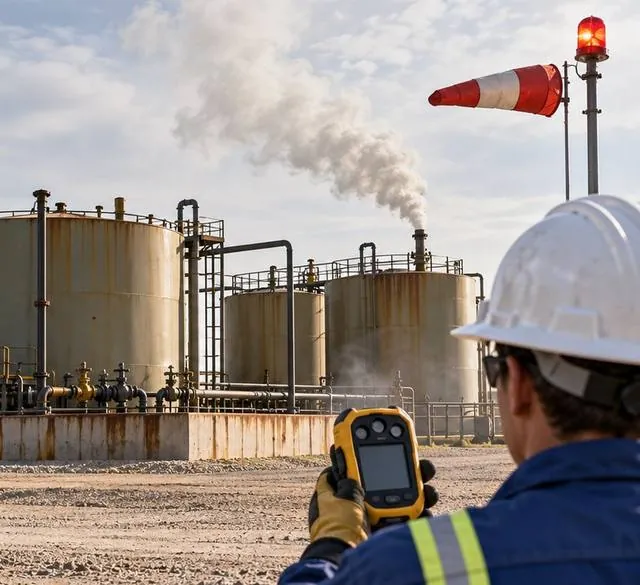
- Training, warning signs, wind indicators and escape breathing equipment
- Fixed alarms that are tested and kept working
- Lockout before pumps and lines are opened, and pump houses that vent
- In Michigan, setbacks, a contingency plan and state inspections for H₂S wells (below)
Odessa, Texas, 2019. At a waterflood station taking produced water from about 68 wells, a pump released water carrying H₂S. The pumper died, and so did his wife, who came looking for him. The U.S. Chemical Safety Board found his personal monitor was in his truck, the station’s alarm system was not working and there was no lockout procedure. Responders measured 150 ppm approaching the pump house; inside, levels were beyond their meters’ range.
Knowing the source tells you how to treat it
- Bacteria: sulfate-reducing bacteria (SRB) breathe sulfate instead of oxygen, feed on organic acids or hydrogen, and give off H₂S.
- Other microbes: some bacteria, such as Halanaerobium, common in fracked shale wells, make H₂S from thiosulfate, and standard SRB tests miss them. Sulfate-reducing archaea matter mostly in hot reservoirs.
- Geology: above about 140 °C (284 °F), sulfate reacts with oil directly. Those wells are sour from discovery.
A quick diagnosisA well that soured after waterflooding or workovers points to biology.
Illinois Basin. Most SRB are active between about 50 and 160 °F (10–70 °C), and 70–75% of the basin’s oil comes from reservoirs shallower than 3,000 feet, at roughly 90 °F.
Sour oil and gas in Michigan, Illinois and Appalachia
We found no published count of sour fields for these basins, but state records and field reports show sour production in all three: from bacteria in shallow wells and from heat in deep ones.
Michigan Basin
About 1 in 8 Michigan oil wells carries more than 300 ppm H₂S. The state’s regulator, EGLE, counts 1,360 of 10,652 producible oil wells.
Michigan regulates them as H₂S wells, with setbacks from homes, a contingency plan before a permit is issued and inspections two to four times a year.
Illinois Basin
Illinois requires protective measures, such as flare lines, warning signs or fencing, once H₂S tops 20 ppm within 5 feet of a wellhead or flare line, and can require a temporary plug while safeguards go in.
At one mature Illinois field, casinghead gas carrying 4% H₂S (40,000 ppm) from 234 producing wells was flared for more than 68 years, until a treating plant using bacteria that turn H₂S into sulfur made it saleable.
Appalachian Basin
In the deep carbonates, heat makes H₂S: a Trenton–Black River well in Bradford County, Pennsylvania, produced gas with up to 0.51% H₂S (5,100 ppm).
In the shale wells, bacteria make it. Sulfide-making microbes dominated the fluids of an Ohio Utica well, and in a Marcellus pilot, wells treated with nitrate and nitrate-reducing bacteria, which compete with SRB, made at least 30% less sulfide than wells treated with biocide.
The bill for sour oil and gas
Every ppm of H₂S adds cost somewhere on the lease, and much of it recurs every month.
- Chemicals that scale with the H₂S. Scavengers are used up as they react. A Gas Research Institute field evaluation put scavenger treating, capital included, at about 4 to 5 cents per Mcf of gas carrying 19 ppm, with operating cost rising nearly in proportion to the H₂S: ten times the H₂S, roughly ten times the chemical.
- Sour-service steel. The 0.05 psia trigger comes quickly in gas wells: at 1,000 psi it is just 50 ppm of H₂S, and at 100 psi, 500 ppm.
- Safety. Monitors, training, alarms, breathing equipment, ventilation, signs and fencing, and the time they add to every visit.
- Sales. Sour gas cannot be sold until it is treated, so on many leases it is flared, and sour crude can face purchaser limits and price penalties.
- Failures. Corroded and cracked rods and tubing, iron sulfide cleanouts, and acid jobs that release more H₂S (Corrosion, Iron sulfide).
The opportunityClearing up H₂S could turn sour oil and gas leases into a big revenue opportunity: lower chemical and safety costs, gas that can be sold, and oil without sour penalties.
What ChainBreaker does about H₂S
ChainBreaker removes the sludge and biofilm where SRB live, and BioActive reports its microbes out-compete the SRB for food and space, so less H₂S is made: less to attack the steel, and less to reach the people on the lease.
At PetroChina’s Qinghai oilfield, microbial treatment took six sour wells to zero H₂S for more than 140 days (case study).
Keep the safeguards. Gas monitors, safety procedures and scavengers stay in place until measurements show a sustained reduction.
Sources for this section
- Hiltek Resource Recovery and BioActive Services, Indiana Oil and Gas presentation (Oct. 27, 2026), slides 2–3, 7–23 and 25
- BioActive Services, ChainBreaker
- BioActive Services, notes on the ChainBreaker microbial consortium and the biochemicals it makes (Oct. 2026)
- Alkan et al., Assessment of the biogenic souring in oil reservoirs, Energies 17(11):2681 (2024)
- USGS Open-File Report 03-037 (Illinois Basin); Indiana High-Temperature Geothermal Assessment (2026); Illinois DNR, About oil and gas in Illinois
- Cavallaro et al., Oilfield reservoir souring during waterflooding, SPE (2005)
- NACE TM0194, Field monitoring of bacterial growth in oil and gas systems; Booker et al., Sulfide generation by dominant Halanaerobium microorganisms, mSphere (2017)
- OSHA, Hydrogen sulfide hazards; NACE MR0175/ISO 15156 summary; RBN Energy, Bakken crude H₂S limits (2013)
- OSHA, Hydrogen sulfide standards (OSHA, NIOSH, IDLH and ACGIH limits)
- Michigan EGLE, Hydrogen sulfide gas (H₂S wells and rules)
- 62 Ill. Adm. Code 240.630, Illinois oil and gas operating requirements (H₂S above 20 ppm)
- SLB, THIOPAQ O&G technology reaps rewards from sour casinghead gas stream (Illinois)
- Laughrey and Kostelnik, Geochemistry of natural gases from Trenton and Black River carbonate reservoirs, AAPG Search and Discovery (2006)
- Hart Energy, Good bugs vs. bad bugs (Marcellus pilot, SPE 170937)
- U.S. Chemical Safety Board, Aghorn Operating waterflood station H₂S release (2021); The Chemical Engineer summary
- B. Ogden, Sulfide stress cracking: practical application to the oil and gas industry, Southwestern Petroleum Short Course
- Self-ignition risks of iron sulfides in sour crude oil storage, AIChE Global Congress on Process Safety (2015)
- Gas Research Institute evaluation, Performance of commercial technology for removing small amounts of hydrogen sulfide (1995)
- Iron and sulfide mass balance from Fe + H₂S → FeS + H₂ (atomic weights)