Wellbore BioChemistry Root cause 1 of 7
Paraffin in Oil Wells: Causes, Costs and the Remedy
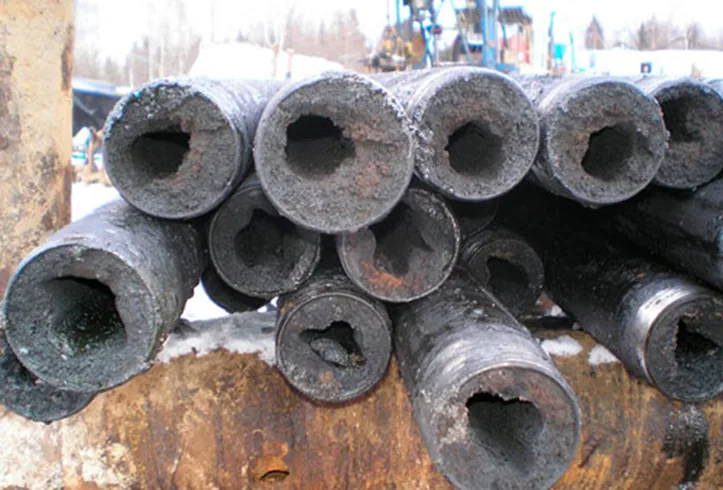
Paraffin wax builds up in the tubing, on the sucker rods and in the flowlines as crude cools on its way to the surface. It drives hot-oil jobs, rod pulls and lost production in stripper, marginal and fracked wells.
Wax that comes with the crude
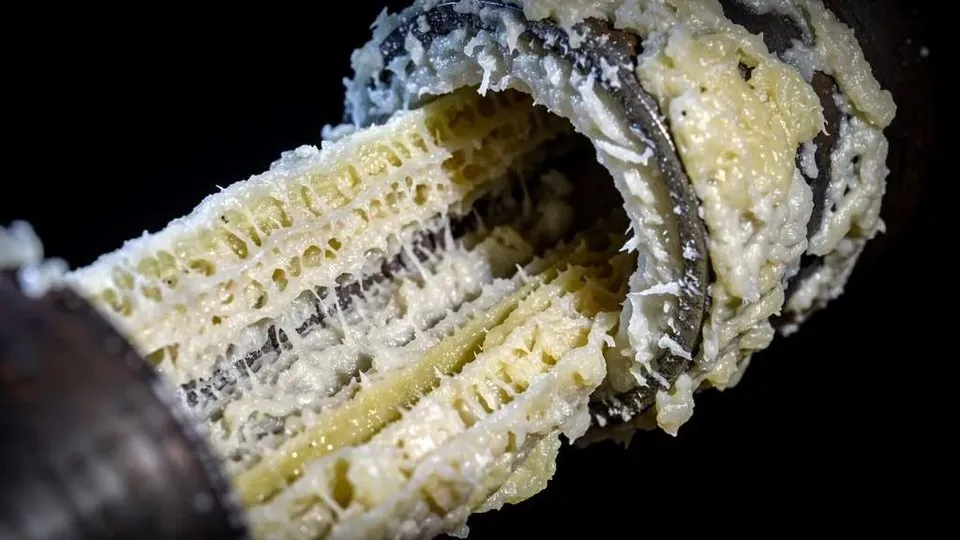 Blockage
- What it is
- Long-chain hydrocarbons, C18 and heavier, dissolved in the crude.
- What causes it
- On the way up, the oil cools below its wax appearance temperature and loses the light ends and gas that keep wax dissolved, so wax crystallizes on the rods, tubing and flowlines.
- Lifting costs: the usual fixes and why they repeat
- Hot-oil jobs, solvent treatments and rod pulls, plus the power to lift heavier rods. They keep coming back because the oil keeps cooling and the long chains keep arriving. An Oil & Gas Journal survey found the best programs hot-oiling or hot-watering monthly on a fixed schedule, and others every 30 to 90 days.
- Hidden cost
- Part of the hot fluid goes into the formation, where melted wax can damage permeability, and wax pushed deeper can harden and stick the rods.
- Profitability
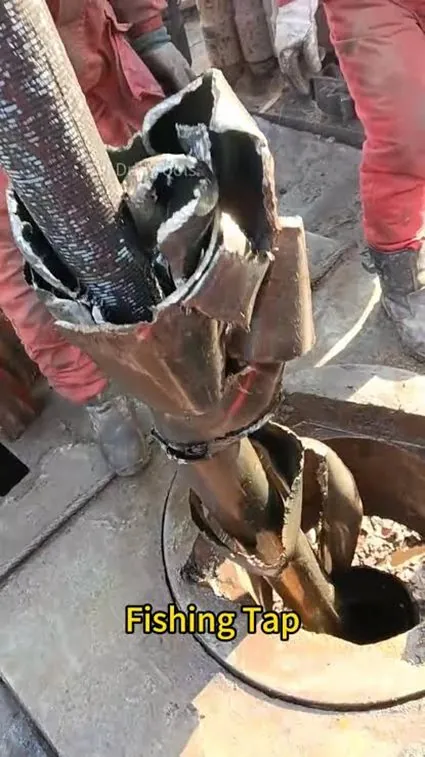
- Wax narrows the tubing until the rate falls, then hangs or parts the rods, and the well sells nothing until it is cleaned out or fished.
- $546 per well a year for hot oiling alone, at 3 to 4 jobs a year, across 427 Texaco wells in West Texas (1988 dollars).
- $47.6 billion a year: the expected worldwide cost of wax deposition, within a range of $14.7–330.6 billion.
What this does to a well’s life: Lifting Costs and Well Life
Sousa et al. (2022, 2023); Hicks, Oil & Gas Journal (1990).
Rod weight and flow: the cost of deferred maintenance
How much production does one hung well cost? What does it cost to fish a separated rod string? Half an inch of wax is enough to put both on the table.
Clean rod
0.00 in of wax
- Added weight per 1,000 ft
- 0 lb
- Tubing flow restriction
- 0%Full flow area open
Deferred maintenance
½ in of wax buildup
- Added weight per 1,000 ft
- ~730 lb
- Tubing flow restriction
- 73.1% lostOnly 26.9% of the flow area left open
Figures from the Hiltek and BioActive presentation. They match ½ inch of wax around a ¾-inch sucker rod inside 2⅜-inch tubing.
What ChainBreaker does about paraffin
BioActive microbes break long wax chains into shorter ones that stay liquid at lower temperatures, and the solvents they make keep the paraffin in solution, so it doesn’t fall out of the oil. Biosurfactants help detach the wax so it flows out with the oil.
It works between treatments, so the wax is handled as the oil arrives instead of after it builds up. On a 100-mile oil pipeline, continuous injection softened the paraffin, and cleaning pigs stopped getting stuck (pipeline case).
Hard, black deposits may be asphaltene, not wax, and need different handling: see how to tell them apart.
Sources for this section
- Hiltek Resource Recovery and BioActive Services, Indiana Oil and Gas presentation (Oct. 27, 2026), slides 2–3, 7–23 and 25
- Hiltek Resource Recovery, Paraffin and Iron Sulfide (FeS) Challenges in Oil and Gas Production: Technical, Financial, and Operational Impacts on Marginal and Stripper Wells (Nov. 2026), including the paraffin-in-tubing and iron sulfide photos
- SPE PetroWiki, Wax problems in production; Sandia National Laboratories and Petrolite, Practical hot oiling and hot watering for paraffin control (SAND94-0390C)
- BioActive Services, ChainBreaker
- BioActive Services, notes on the ChainBreaker microbial consortium and the biochemicals it makes (Oct. 2026)
- BioActive Services, Paraffin and Asphaltene Control
- Ji et al., Structural insights into diversity and n-alkane biodegradation mechanisms of alkane hydroxylases, Frontiers in Microbiology (2013); Agrawal and Gieg, In situ detection of anaerobic alkane metabolites in subsurface environments, Frontiers in Microbiology (2013)
- A. M. Sousa, T. P. Ribeiro, M. J. Pereira and H. A. Matos, On the economic impact of wax deposition on the oil and gas industry, Energy Conversion and Management: X 16, 100291 (2022); Review of the Economic and Environmental Impacts of Producing Waxy Crude Oils, Energies 16 (1), 120 (2023)
- G. A. Hicks (Texaco), Uniform program reduces paraffin removal costs, Oil & Gas Journal (Aug. 20, 1990)
- K. Ivanhoe and J. Herman, Paraffin, asphaltene control practices surveyed, Oil & Gas Journal (July 12, 1999)