
Wellbore BioChemistry Root cause 3 of 7
Iron Sulfide (FeS) in Oil Wells: Causes, Costs and the Remedy
Iron sulfide forms where H₂S meets iron in the well. It is the black deposit behind “black water” and “black wax,” and acid jobs alone don’t keep it away.
What it is and what it costs
Black solids that plug the well and resist acid
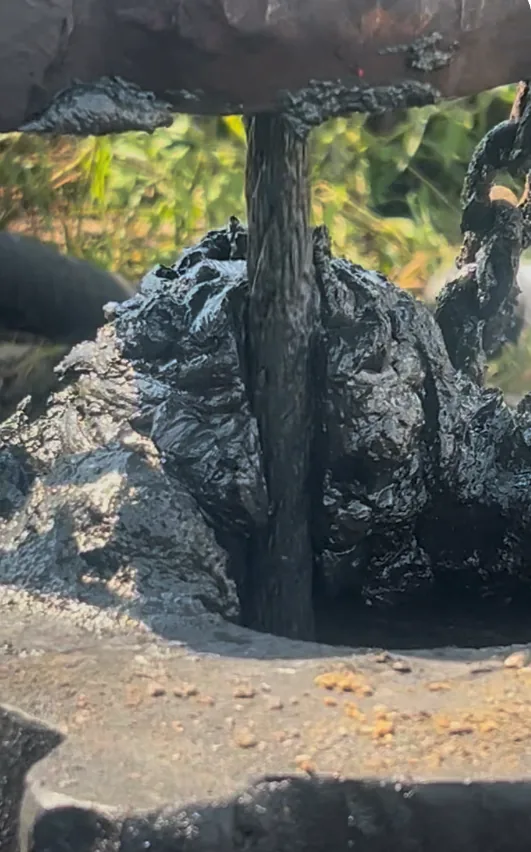 Blockage
- What it is
- Black iron–sulfur solids, from soft sludge to hard crystalline scale.
- What causes it
- H₂S reacts with iron from corroding steel and acid jobs.
- Lifting costs: the usual fixes and why they repeat
- Acid jobs and dissolvers, again and again: it comes in several mineral forms that no single treatment clears, and new deposits form as long as corrosion and bacterial sulfide feed them.
- Hidden cost
- Hydrochloric acid dissolves it but releases toxic H₂S, which adds safety and handling costs and speeds up tubing corrosion and formation damage.
- Profitability
- It plugs perforations, screens and pumps, and it helps hold water in the oil as emulsion.
- No published study isolates iron sulfide well by well. Its cost shows up as acid jobs, workovers and replaced tubing and rods, and researchers call the cost of treating it “very high.”
What this does to a well’s life: Lifting Costs and Well Life
Gamal et al. (2020).
How it forms
What H₂S leaves behind
- On bare steel: on bare steel, Fe + H₂S → FeS + H₂, the same reaction that corrodes it. Dissolved iron that meets H₂S drops out as black particles: “black water.”
- Black wax: wax binds iron sulfide fines and slime into hard “black wax.”
- Fire risk: dried and exposed to air, iron sulfide can ignite on its own, a known cause of tank fires and explosions during maintenance.
The remedy
What ChainBreaker does about iron sulfide
ChainBreaker cuts the sulfide supply, so less new iron sulfide forms. BioActive reports its microbes break iron–sulfur bonds in FeS, using the sulfur to grow and dispersing the iron, which clears “black water.” Biosurfactants help detach the solids from steel and rock.
With no acid in the program, there is no acid to free H₂S from the deposit or to eat the tubing.
Sources for this section
- Hiltek Resource Recovery and BioActive Services, Indiana Oil and Gas presentation (Oct. 27, 2026), slides 2–3, 7–23 and 25
- Hiltek Resource Recovery, Paraffin and Iron Sulfide (FeS) Challenges in Oil and Gas Production: Technical, Financial, and Operational Impacts on Marginal and Stripper Wells (Nov. 2026), including the paraffin-in-tubing and iron sulfide photos
- BioActive Services, ChainBreaker
- BioActive Services, notes on the ChainBreaker microbial consortium and the biochemicals it makes (Oct. 2026)
- S. Genculu, Microbiologically Influenced Corrosion (PDHonline course M507); Enning et al., Corrosion of iron under electroconductive biogenic mineral crust, Environmental Microbiology (2012)
- WorkSafeBC, Storage tank exploded at sour gas well site
- Hamza et al., Review of iron sulfide scale removal and inhibition, Energy & Fuels (2021); Brawley et al., Removing a typical iron sulfide scale (SPE 24327, 1992); Long, Preventing emulsions by mitigating solids, JPT (2016)
- H. Gamal, S. Elkatatny, D. Al Shehri and M. Bahgat, A Novel Low-Temperature Non-Corrosive Sulfate/Sulfide Scale Dissolver, Sustainability 12 (6), 2455 (2020)